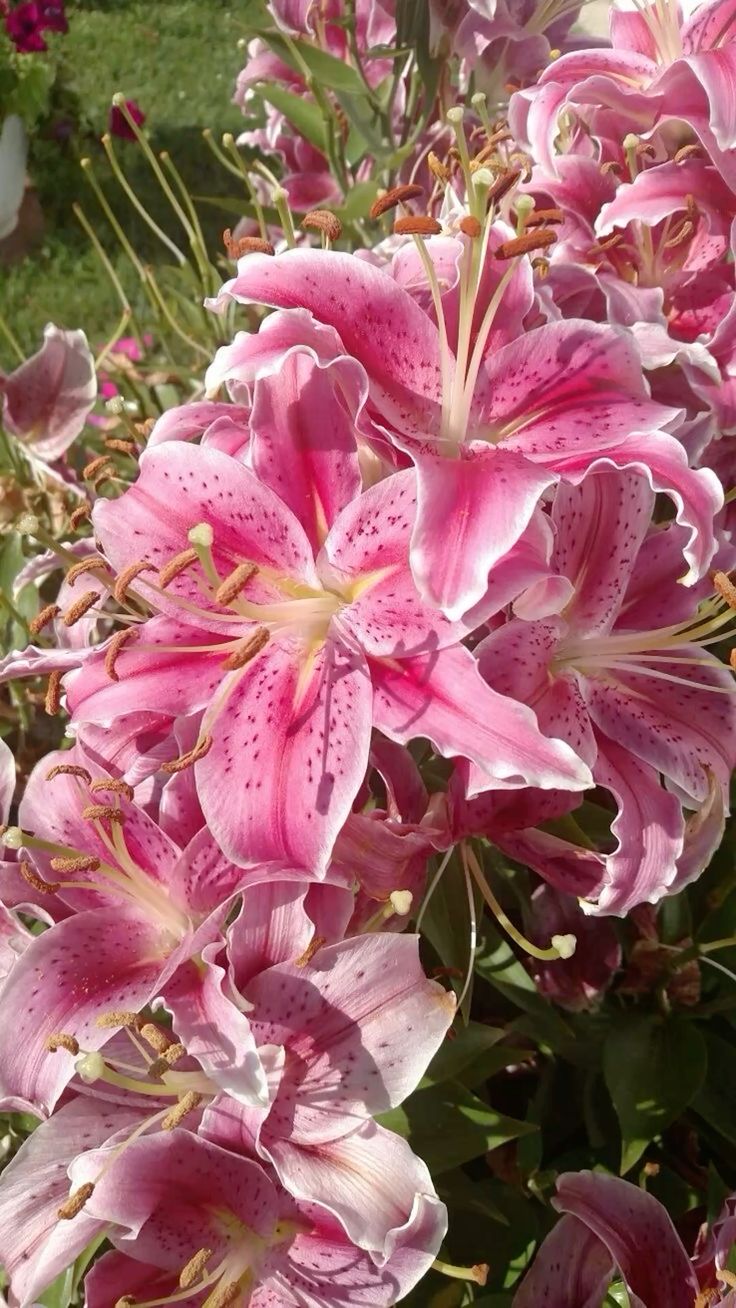
Hover over a marker to explore
the plant’s anatomy.
On mobile, tap a marker.
Flower
The reproductive structure of the plant.
Stamen
Male reproductive structure consisting of a filament and anther.
Anther
Pollen-producing portion of the stamen.
Filament
Supports and positions the anther.
Fruit / Seed Capsule
Mature ovary containing the lily's seeds.
Seed
Structure containing the plant embryo that can develop into a new plant.
Leaf
Main photosynthetic organ.
Stem
Supports leaves and flowers and transports water, minerals, and sugars.
Bulb
Underground storage organ composed largely of modified fleshy leaves.
Bulb Scale
Fleshy modified leaf that stores nutrients.
Roots
Absorb water and minerals and anchor the plant.
Flower Bud
An immature flower before opening.
Tepal
One of the six colorful, petal-like structures surrounding a lily's reproductive organs. A lily has two sets of three: three outer tepals corresponding to sepals and three inner tepals corresponding to petals. Because the two sets look so similar, botanists commonly refer to all six collectively as tepals rather than separating them into sepals and petals.
Pistil
Female reproductive structure of the flower.
Flower
The reproductive structure of the plant.
Stamen
Male reproductive structure consisting of a filament and anther.
Anther
Pollen-producing portion of the stamen.
Filament
Supports and positions the anther.
Fruit / Seed Capsule
Mature ovary containing the lily's seeds.
Seed
Structure containing the plant embryo that can develop into a new plant.
Leaf
Main photosynthetic organ.
Stem
Supports leaves and flowers and transports water, minerals, and sugars.
Bulb
Underground storage organ composed largely of modified fleshy leaves.
Bulb Scale
Fleshy modified leaf that stores nutrients.
Roots
Absorb water and minerals and anchor the plant.
Flower Bud
An immature flower before opening.
Tepal
One of the six colorful, petal-like structures surrounding a lily's reproductive organs. A lily has two sets of three: three outer tepals corresponding to sepals and three inner tepals corresponding to petals. Because the two sets look so similar, botanists commonly refer to all six collectively as tepals rather than separating them into sepals and petals.
Pistil
Female reproductive structure of the flower.
Growing Guide
☀ Light
TEST LIGHT
Water
test water.
Soil
test soil
🌡 Temperature & Humidity
test temp&humid
Fertilizer
test ferti
Pruning
test prun
Propagation
test prop
Pests & Diseases
test pests
Common Problems
test common
Habitat & Ecology
Native Habitat
test native habitat
Geographic Distribution
test geographic distribution
Climate
test climate
Hardiness
test hardiness
Wildlife Value
test wildlife value
Pollinators
test pollinators
Invasive Status
test invasive status
⚠ Toxicity
Toxic Parts
test toxic parts
Toxic Compounds
test toxic comp.
Symptoms
test symptoms
Humans
test humans
Pets
test pets
Livestock
test livestock
Birds & Wildlife
test birds and wildlife
First Aid
test first aid
Medical Treatment
test med treatment
Poison Center Advice
test poison center advice
History & Culture
Discovery
test
History
test
Symbolism
test
Cultural Importance
test
Folklore & Mythology
test
Historical Uses
test
Floral Design
Vase Life
test
Conditioning
test
Floral Design Uses
test
Season Vibes
test
Sources & Editorial Standards
Plant Encyclopedia prioritizes information from university extension programs, peer-reviewed research, botanical institutions, government agricultural agencies, and other authoritative horticultural sources. Where appropriate, information may also be drawn from professional growers, breeders, and other primary horticultural sources.